
Sandcage
Run AI coding agents in isolated Docker containers — your machine stays yours.
---
> [!CAUTION]
> **⚠️ Unreleased Software ⚠️**
>
> 🚧 This project is under active development and **not yet released**. APIs, configuration formats, and behavior may change without notice. Please **do not use without contacting the author** about the current state of the project. 🚧
> [!WARNING]
> **⚠️ Development Tool Only ⚠️**
>
> 🚧 Sandcage is designed for **local development use**. Do **not** use it in CI pipelines or production environments — container isolation is not yet hardened for those contexts. 🚧
### Planned Features
- **Support for custom harnesses** — bring your own agent runtime, not just Claude Code and Codex
- **Full encapsulation hardening** — for worker and CI environments, ensuring complete sandboxing of file system, network, and credentials
- **ACP integration** via [`dirigate`](https://github.com/dirigence/dirigate) — Agent Communication Protocol support for structured agent orchestration
---
## Why Sandcage?
AI coding agents need broad access to do their work: shell, filesystem, network. Letting them run directly on your machine means they share your credentials, your session history, and your entire environment.
Sandcage gives each agent its own container with the tools it needs. Your project is mounted in, changes are visible on the host, but the agent never touches your shell config, your SSH agent, or anything else outside the sandbox.
Multiple agents can run side by side. A persistent home directory means config and credentials survive between sessions, so you are not re-authenticating every time.
## How It Works
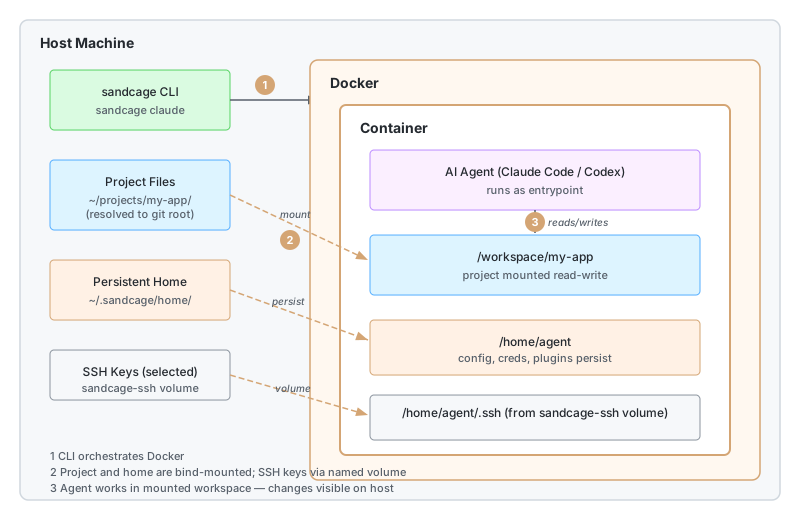
1. You run `sandcage claude` (or `codex`, or `shell`) from your project directory
2. Sandcage resolves your workspace to the git root and builds Docker compose arguments
3. Your project, persistent home, and (optionally) SSH keys are mounted into the container
4. The agent runs as the container entrypoint, working in the mounted workspace
5. All file changes are immediately visible on your host
## Quick Start
### Prerequisites
- **Docker** (daemon must be running)
- **Rust toolchain** (cargo) — or download a prebuilt binary from [Releases](https://github.com/dirigence/sandcage/releases)
### Install
```bash
cargo install --git https://github.com/dirigence/sandcage
```
### Build images and run
```bash
sandcage build # build base and codex images
sandcage claude # start Claude Code in the current project
```
That is it. Sandcage resolves your project to its git root, mounts it into the container, and drops you into the agent.
### More commands
```
sandcage claude -p ~/project # run in a specific project
sandcage claude -- --resume # forward args to the agent
sandcage codex -p ~/project # run Codex instead
sandcage shell # interactive shell, same environment
sandcage claude --shell # shell in the Claude image (debugging)
sandcage init # detect ecosystem, generate .sandcage.yml
sandcage setup ssh # select and copy SSH keys for containers
sandcage setup ssh --global # store SSH config globally
sandcage setup ssh --refresh # re-sync keys after changes
```
## Configuration
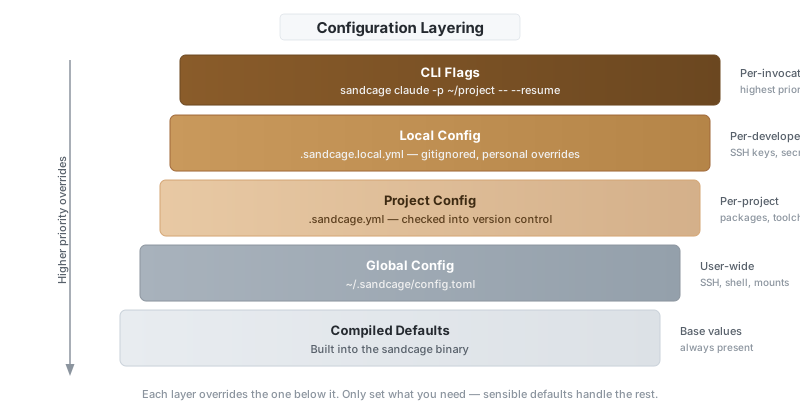
Configuration is layered. Each level overrides the one below it, so you only set what you need:
**Compiled defaults** — sensible out of the box
**Global config** (`~/.sandcage/config.toml`) — user-wide preferences
**Project config** (`.sandcage.yml`) — per-project setup, checked into version control
**Local config** (`.sandcage.local.yml`) — personal overrides, gitignored (SSH keys, secrets, local mounts)
**CLI flags** — per-invocation overrides
### .sandcage.yml example
```yaml
packages:
- ripgrep
- fd-find
toolchains:
rust: stable
node: "20"
env:
DATABASE_URL: "postgres://localhost:5432/dev"
agent_args:
claude:
- --dangerously-skip-permissions
shell: zsh
```
SSH key access is configured separately via `sandcage setup ssh`, which selects only the keys needed for git and copies them into a dedicated Docker volume.
Run `sandcage init` to generate a starter config — it detects your project ecosystem (Rust, Node, Python, Go) and suggests appropriate toolchains and packages.
## Docker Image
Sandcage uses a single image (`sandcage`) based on Debian bookworm-slim, packed with dev tools: git, openssh-client, ripgrep, fd, jq, curl, zsh, bash, sudo, just, and uv.
AI agents (Claude Code, Codex) are installed on first run into the persistent home directory and auto-update themselves — no agent binaries baked into the image.
Build with `sandcage build`. Use `--force` to rebuild unconditionally.
## Cross-Platform
Sandcage works on **Linux**, **macOS**, and **Windows** (PowerShell, cmd, and Git Bash). On Windows with WSL, it works from both the Windows and Linux sides.
## License
MIT